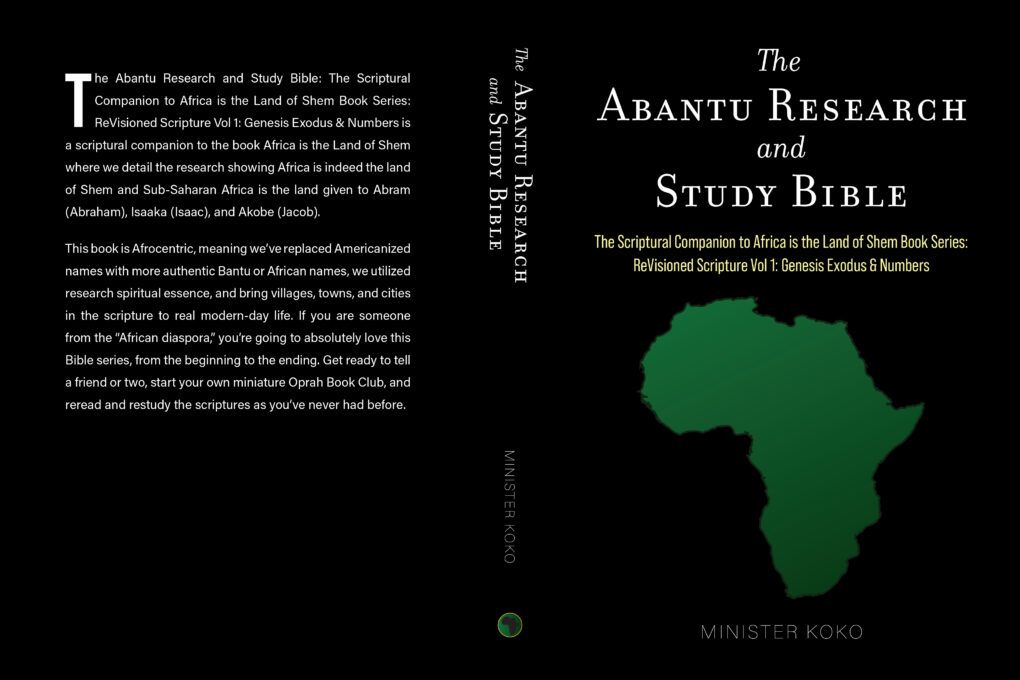
Welcome and greetings to this project. I’m your host; I am Minister Koko. This project began as a larger or expanded version of the short story book we put together titled: Africa is the Land of Shem.
That project began 16 years ago and even for years before that when my younger brother and I started to really dive into the Scriptures. We used to use the Scriptures to make our intelligent rap career sound and become more intelligent. But as we dived in, we learned a lot more about the Bible’s rewritten history.
An interesting scripture came to the forefront of my mind that stated the lands that were given to the forefather Abram. In addition to the land promised to him, lands were also given to his descendants who became known as the children of Israel and the house of Jacob.
Gifted Land Did Not Add Up
When I pulled out a globe or a worldwide map, I was astonished the small patch of land called Israel and Palestine today was the land given to the house of Jacob for an inheritance. I thought to myself something is off.
The Great Creator said, “Let us reason together (Isaiah 1:18),” and so I prayed and asked why that was the case that the Great Creator would, metaphorically, pull out of His wallet hundreds of trillions of dollars and give the children of Jacob, His firstborn, His apple of the eye, His well-beloved, His Kingdom of Priests, His Royal Diadem, giving them a couple of nickels.
With all the land on the earth today, why would the Great Spirit give them a tiny bit or strip of land? That’s like pulling out trillions of dollars in your wallet and handing your “great son” $.10. No knock against that land, it’s just it doesn’t make ideal sense. However, not a Researcher at that time I did not know how to otherwise prove it incorrect so the promptings of the Holy Spirit in my mind kind of lay dormant but I never disregarded or discarded the idea, I was just around people who did not help me chew on the idea better.
Resources
Then came websites or YouTube channels like promised2bless, truth unveiled, and the prophet Michael Massa; I owe a great deal to these brothers and men of the Great Creator. They were sharing what I was receiving in my mind from the Holy Spirit. I encourage you to look at their work and body of teachings.
In my opinion, they are prophets, thus they speak directly so sometimes it can be difficult to organize their wording in a learning matter. And I say that with no disrespect! To me, I learned in story form and in plain organize step by step, and that is what I hope the books that I am putting together with our team can do for you and allow you to see the beauty in the truth.
Two more men and brothers that I would be remiss to mention in this introduction that really helped me along this path. Lee Cummings author of the book series the Negro Question is where I kind of heard the word “Bantu,” for the first time (at least on a conscious level). His research is extraordinary.
The other man is Elder Nkosi. He put the picture together for me and thousands of others within Bantu International. From everyone I’ve mentioned, you are receiving a piece of their spirit in this work.
My last and greatest resource of men are, of course, my brothers and late father apostle Ndueso; he made sure to teach my brothers and me who were raised in the American system the important values of our culture and who we were and are that we are Ibibio men from Ikot or the village of Obioko, in Akwa Ibom State, Nigeria!
Even when we joked around saying we were New Yorkers we will act as New Yorkers, from the scene in the movie “Coming to America,” my dad would not relent in making sure his identity was secure all over him and expressed to us. I learned first from him as a child that we were Jews, Hebrews, Ibri, Ibibio, people of the Great Spirit/Great Creator, known in our language as Abasi Ibom. And we the Ibibio people have been in that land for the last 2,500 years!
Here are some things you should know as you read. What is Abantu or Bantu? Abantu or Bantu simply means the People. This is from South African History Online (SAHistory.org.za, an article on Defining the term “Bantu.” The excerpt below is from Kees van der Waal’s chapter in “Critical Essays on Afrikaans Places of Memory.” See below:
The term ‘Bantu has gone through various shifts in meaning. It has had both positive and negative meanings, depending on the “historical moment, social positionality and experience of users”. [K. Van der Waal. “Bantu: From Abantu to Ubuntu” in A. Grundlingh, S. Huigen. Reshaping Remembrance: Critical Essays on Afrikaans Places of Memory. (Rozenberg, Amsterdam, 2011). p. 33.]
In its indigenous sense, it relates to the kinship between numerous African languages. In Anthropology, the term was used to refer to the people that spoke these languages. Abantu (or ‘Bantu’ as it was used by colonists) is the Zulu word for people. It is the plural of the word ‘umuntu’, meaning ‘person’, and is based on the stem ‘–ntu’ plus the plural prefix ‘aba’. This original meaning changed throughout the history of South Africa.
It is a term used in archaeology, history, and anthropology:
(1) It named a major linguistic group in Africa, and more locally, to identify the sizeable group of Nguni languages spoken by many Africans in sub-Saharan Africa, and
(2) It identifies those Bantu speakers who spoke that group of closely related languages which linguists divide into four categories: Nguni, Sotho-Tswana, Venda, and Tsonga-speakers.
Although the linguistic and grammatical structure of the different languages had similarities, it is important to note that the Bantu-speaking peoples are not a homogenous group. [p.34] They comprise more than 100 million Negroid people who live in southern and central Africa, ranging from Nigeria and Uganda to South Africa, and who speak about 700 languages, including many dialects.
How these languages spread into southern Africa remains uncertain. Today archaeologists agree that the forbears of such Bantu speakers as the Kalanga, Karanga, and Venda achieved a height of material cultural development in the tenth and fifteenth centuries. They built beautiful structures, pits, and fortresses, including the Zimbabwe Ruins, which spread across Zimbabwe into Botswana. These fortresses are also found at Mapungubwe and other places in the northern regions of South Africa.
Again, in essence, Abantu or Bantu means the People.
They, we, at large are the children of Akobe (Akobi, Yakobe, Jacobi, Jacob in the KJV Scriptures). Akobe is the son of Isaaka (Isaaca or Isaac in the KJV Scriptures), and he is the son of Abram (Abraham). The story the Christian world calls a collection of books, the Bible, comes from the ancestors of the Bantu people.
And the men I mention afore are not the first to speak of this; men before them, scholars, who were not permitted to have their works published have written on these topics and more. However, the Great Spirit has a time for everything, and the time is now for truth, awakening, and true unity.
You will notice names spelled differently throughout the scriptures in this publishing; you will notice some things without reference. In some areas, we want to challenge you, challenge you to do your own research, or even allow the Spirit to guide you to a conclusion.
Also, you’ll notice that we refer to God as the Great Creator or the Great Spirit; we refer to the Lord as the Almighty or the Great Spirit or Almighty Spirit. We arranged chapters in the best Spirited-led way we could for chronological comprehension and story flow. We even rearranged verses.
Ultimately, this Abantu (Abanatwa) research and study Bible is ideally to point out geographical locations as they pertain to the scripture in the reworked truth, acknowledging Africa as the land of Shem and Sub-Saharan Africa as the Land given to Abram, Isaaka, and Akobe, the Land of the Bantu.
